Showing posts with label History. Show all posts

Wednesday, December 29, 2010

They Call Me Caterina...

-
... this is my story.


In Italy, it was the common name given to the slaves from the Constantinople, today's Istanbul, Caterina.

Her son traveled to Turkey and Azerbaijan to disc
over his Caucasian roots. His findings as well as researches say his mother was hailed from... Azerbaijan and a Muslim. This very well-researched novel about the mother of Leonardo da Vinci (1452-1519), slave mother Caterina da Vinci, is the best work I have ever read in a long time!


A very colorful story of her relationship with her son who was destined to change the world forever; from his growth, his creative and inventive side to how daring is why his mother felt she had to protect him so long.


Warning: Anyone not interested in historical romance, Turkey and Renaissance Florence
will not enjoy this truly captivating book.


"All other cities are doomed, but I imagine that as long as people exist, Constantinople will exist."
~Petrus Gyllius
French scientist,
(Albi, 1490 - Rome, 1555)


Sunday, December 19, 2010

Voice Of The Angels

-
When I head down the Istiklal Street of Beyoğlu disctrict on the European part toward the Tünel Quarter, there is a gorgeous greeting just few meters away from St Anthony Church that I love standing on the stairs and looking at this beautiful golden mosaic, depicting the Santa Maria standing on a seashell carried by two angels:


Santa Maria Draperis Church is only one in Istanbul to have the signature of Sultan, that plaque located above the door. The Ottoman Empire's Sultan Abdülhamid II gave his permission for the construction of that church and Rıdvan Pasha, the mayor of Istanbul supported the construction.

Being one of the oldest and holiest Roman Catholic icons in Istanbul, the Santa Maria was built by Genoese Nicolo Draperis in 1584, who was the famed merchants in Galata. Interior of the Church is also interesting and colorfully ornamented, I love it! Sculptor Lorenzo Gerotti brought the marble used for the altar from Italy, and worked on the main hall which both the altar and chancel area feature late baroque and roman catholic styles. Sources say that, this Church survived the great fire in 1881 with a very little damage while other churches in the town were destroyed. Then, Architect Guglielmo Semprini supervised the re-building and renovated.

Apart from being a fine mixture of western and Ottoman architectural forms, Santa Maria Draperis Church stands as unique senthesis of tolerance and appreciation between religions, Christianity and Islam. I am very lucky coming from a beautiful City that is really crossroads and best example for the values.

Turning down the page for 2010. Will we be able to see good tolerance and understanding in 2011's world? Who's the best; hindu? buddist? christian? ateist?
Why religion still important problem? What's the point missing, respect or tolerance? Should I select my (blog) friends according to his/her religion?

Unfortunately the same problem exists on this "blogging" community!

A bit of my Joan of Arc soul would like to fight for it...


*you can enlarge my photos*


Sunday, December 05, 2010

Mozart Sunday In Turkey

-
In Vienna there is a park called "Türkenschanzpark", means Turkish trench park. The words inscribed in Turkish and German on the fountain that was erected in this green area exhibit the traces of Ottoman influence: "The heart is the home of the friend, I came to give heart."


Combing the golden pages of our great history, of our great the Ottoman Empire.

Beginning of the 17th century. Stretching from southern Hungary to Jerusalem, to Mecca, to Cairo, and to the earternmost frontier in Algeria. The most powerful state in the world, the Ottoman Empire reached its largest historical size! Famed for its strong and efficient central government, military power and extraordinary wealth at its height. The Ottoman's ambitions extended all the way to Austria...

The 1st Siege of Vienna in 1529, led by Sultan Suleiman l the Magnificent.

1600's... Sadly those years marked the beginning of a long and slow decline that would lead to the dissolution of the Empire 300 years later, after World War I.

Then again in 1683, the 2nd Siege of Vienna. Ottoman leaders was hoping a new victory might restore the Empire to its full glory. After this 2nd siege of Vienna City, the figure of Turk and also Turkish Culture -exotic clothes, harems, to waterpipes- became popular throughout Europe. Turkish characters cropped up in all sorts of plays and operas.

Although in Mozart's time (Salzburg, Jan 27, 1756 - Vienna, Dec TODAY, 1791), the Ottomans ["Turks"] were no longer a serious threat to the Viennese or all Europe, it was still a recent memory.
Made Mozart inspired by the Ottoman siege, above you played his famous Turkish March.

I like our March, the great Musician's piano sonata A major, a gift to Turks in highest value. So Turks are important for Mozart. And, Mozart for us. TODAY remarks the day of
a man's 219th death anniversary that is highly avant-garde piece of music. Thank you, Mozart, we all love you.


Tuesday, November 09, 2010

White Heaven

-
L' antica città di Ierapoli fu probabilmente fondata da Eumene ll, re di Pergamo, nel 11 sec. A.C. Si suppone che il nome della città derivi da Iera, moglie di Telefo, antenati leggendari dei re di Pergamo.


Il nome di Ierapoli fu interpretato da alcuni anche come "città sacra". Tutte le rovine della città, tranne le fondamenta del tempio di Apollo, risalgono al'epoca romana imperiale.


Le terrazze di Pamukkale si sono formate naturalmente grazie all' acqua calda ricca di bicarbonato di calcio che scorre nella zona ad una tempura di 35gradi. Quando di biossido di carbonio, presente nel bicarbonato, a causa di una reazione chimica, si libera, deposita carbonato di calcio sul fondo dell'acqua. Questi depositi prendono diversi colori e forma oltre alle vasche, formano cascate e stalattiti.
Una città ellenistico-romana della Frigia "Pamukkale", che in turco significa "Castello di Cottone" prende il suo nome da quente formazioni.


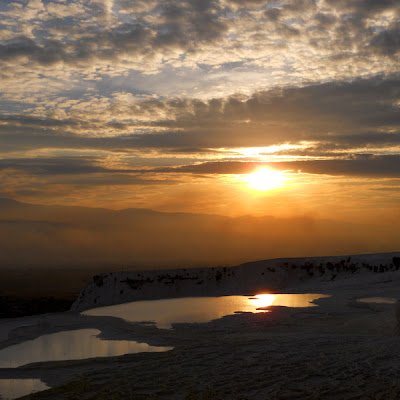


With its white and clean therapeutic calcium terraces "travertine pools" and natural geological wonder, "Cotton Castle", as we say in turkish Pamukkale is on the plateau at the top of ruins of the ancient Roman Bath Town Hierapolis. Very unique in the world and preserved by UNESCO Heritage. This area that blessed city Denizli in southwestern Turkey inspires many people tourists to artists coming to the warm spring waters that bubble to the surface that was a source of life for Hierapolis, one of the most prominent health centers of antiquity.
Have to say, the average age visiting the region was, naturally, 115:) Tourists were coming mostly from the States, and following them France, Germany and Japan.

You can SWIM here, all year around, even in SNOW, and highly recommended not to leave without having a bath
in the sacred pools where both Romans and Greeks that enjoyed historically! We stayed in Pam Thermal Hotel, in Karahayit, famous as a health center complex. Late evening I liked very much swimming in the healing powers of its minerals in red water that our Hotel provides (below). Amazing experience, love it!


Please click on my photos for larger size and
learn more about it:


Tuesday, September 21, 2010

Meet Fairies In Anatolia

-
This summer I was celebrating turning another year younger here:) I did not want to take a break from my fairies meet up. I did not want to leave my cave. I did not want to say goodbye to beautiful horses. I did not want to come back to Istanbul. I did not want to stop watching balloons. I loved so much being there! When I was on my way back to home at the airport in Ankara, I promised myself one thing: Yes, I will. I could not get satisfied exploring you. I will come again, wait me, pretty soon, maybe sooner than yesterday.


Several millions years of erosion of the earth formed the strangest, magical region of so called Fairy Chimneys..


Exceptional with its surrealistic landscapes saw the penetration of Christianity on the footsteps of St Paul in the middle of mainland Anatolia..


The first Christians came to settle in the natural grottoes..


And, they created the rock-carved churches and amazing underground cities in this UNESCO heritage land called Cappadocia, Kapadokya as we call in turkish. They painted the churches with brilliant and simple colours relating the important episodes of the Bible. Resources say that the apogee of Byzantine and Christian Cappadocia took place between the beginning of the 10th century and second half of 11th century.

I would advise you those five-F, please check out:


.Fine Read: All About Land of Beautiful Horses your expert
.Fabulous Play: Did You Ever Try Crossgolf? so inspiring
.Fantastic Cavehome: Come, Stay Here like me get the Spa
.Feel Salutes of God: Caravansarai oh meet whirling dervishes
.Fun Fly High: More than a ride on clouds suuuuper hot balloons


Friday, September 17, 2010

Antique Art Potteries

-
Beautiful floor mosaic with amphoras and,
wonderful large Amphora Park

can be found in one of the most important
Underwater Archaeology Museums in the world,
in Bodrum


Italian Amphora ~ 1st AD


Roman Amphoras ~ 3th AD


4th Cent AD


Manufacturing Amphoras


The clay for the manfacture of amphoras was made more resistant by adding mica, sand and lime. The mixture was then trampled to get rid of the air bubbles and left to rest it for a while. Amphoras (turkish: testi) were made on a patter's wheel. The amphora was then left to dry in a shady place before being fired at a temperature of 800 - 1000 degrees.


The ridges observed on the inside curves of the large amphoras show where the neck joins the shoulder and the base joins the body. The illustrates that an amphora is made in several parts.


The kilns were either rectangular, round or pear-shaped and 3-5 mm high. Most kilns had the capability of firing 80 to 100 amphoras at one time.


5th - 6th Cent AD


7th Cent BC


14th Cent BC


20th Cent Amphoras


With the added mystique of the Knights of St John who bui
lt the St Peter's Castle is housing the Museum. To me, it is the Bodrum's finest attraction. The Museum is housing the ancient Mediterranean life with the world's biggest Eastern Mediterranean Amphora Collection. The interesting murals can be seen here.

Men trying to find new forms for storing and transporting their
oil, wine, olives, wheat barley created these amphorae. According to the type of cargo, this amphorae had isolation with resin, wax or gum. They were produced especially at great trade or wine producing centres. So these were easily identifiable because of their shapes and forms.

Their forms with pointed ends enabled people to store hundreds of them together as well as carry those easily. People put straw, bushes to protect the ship hull and also prevent the breakage of those amphorae. Their mouths were shut with terra cotta or with quarks. The stamps on the hands of amphorae revealed us the names of manufacturers and the guaranty of the city. Knidians used bullhead, Coans used crab, Rhodians used rose as their symbols.

Besides the storage functioning, amphoras has been greatest help for archaeologoists to locate the site of ancient shipwrecks. Since the hull, wooden part if the ship disappeared, amphorae were only objects survived and became pointers for ancient ships. This feature also attracted attention of divers and sponge divers all these years. Many of these amphoras plundered or decorated the fish restaurants of the region.

Would love to hear your thoughts about amphoras if you have any.. :)


ps- my photos to enlarge please click on.


Wednesday, September 08, 2010

May I Suggest: PRAY

-
There are many interesting places to visit here which tell the story of Istanbul's past...

~please click on my photos to enlarge~


Unlike any other one in the city! Series of coloumns supporting low-ceilinged space. Vaulted maze supported by squat pillars. Little compartments for private prayers. Housed underground in a crypt of the former Castle of Galata. Tradition has it that the chains that prevented unwanted ships from entering to Golden Horn were anchored right here. So during the Byzantine times, the Golden Horn was controlled from here.


Inside the chapel, there are two important tombs of two Arab soldiers (above), and one inside a seperate glass case.


In the Ottoman conquest, the Castle destroyed, and the ruin remained was converted into mosque in 1757. Widely known Underground Mosque (Turkish: Yeralti Camii), in turkish known as Kurşunlu Mahzen Camii (English: Gunpowder Warehouse Mosque) is situated in the old historical part of the City, Karaköy.

The girl was happy to take the day off. The girl was happier to having spent her day visiting significant mosques in the last day of her fasting month. Communing with believers and praying in pretty nice sacred houses, she is now feeling ready herself to "move" next year. Began on Aug 11, the holiest month of the year, Ramadan, ends today. The girl is sad, but...

.. believe that the month of brotherhood and renewal of relationships will certainly feed us in more ways than one.


Where is the Underground Mosque?
Kemankeş Cad. Karantina Sok. No: 20 Karaköy; on the side of the Karaköy ferry port.


Thursday, September 02, 2010

Ancient Mediterranean Life

-
Byzantine. Canaanite. Roman. Geyre..

from the island of Chios. from Palestine. from Knidos. from Egypt..

from 14th c. BC, 1-6th c. AD, 20th century..

for storing and transporting their wine, olive oil, olives, dry foodstuff..

men created them in different shapes and different forms..

* click on murals to enlarge *


I am talking about the biggest wonderful collection of historical artifacts on display in the Bodrum Museum of Underwater Archaeology.
It is about amphoras! Formed from two Greek words: anfi, meaning two-sided and phora, meaning transportable.

Did you know the world's biggest Eastern Mediterranean Amphora Collection is found in this Museum located in St Peter's Castle in Bodrum. I enjoyed very much seeing them all and also two-handled portable jugs with a pointed bottom. More pictures and details from the Museum soon, check back!